


Smart Agriculture

Water when your field needs it

Sensors in the soil and a weather station show you how much water the roots have and what the weather is doing on your farm. You decide on irrigation and spraying from measurements, even remotely.

Free first meetingAcross Greece
Smart AgricultureOlive grove, 30 cm depth
Within limits
–
Root zone soil moisture
Min, 60′
–
Max, 60′
–
Battery
–
Signal (RSSI)
–
Sample data · one reading per minuteLast reading: now
Overview

Measurements from your own farm

Weather forecasts and experience help, but they do not tell you how much moisture is at the roots today. A soil moisture sensor measures at one or more depths and sends the value many times a day. You see when water reaches the roots and when it starts to run short.

LoRaWAN covers several kilometres in open terrain, so one gateway at the barn or the house can cover the whole farm. Where there is no internet, the gateway connects over 4G or Starlink and runs on solar power. The sensors run on batteries or a small solar panel.

What you can monitor

Applications

Irrigation scheduling

Soil moisture at different depths shows when and how much to water. You avoid overwatering and plant stress.

Weather station

Temperature, humidity, rainfall, wind and solar radiation on the farm itself. The data also feeds disease prediction models.

Valve control

Valve controllers open and close irrigation from your phone, or automatically when moisture drops below a limit.

Greenhouses

Temperature, air humidity, CO₂ and light inside the greenhouse. You get an alert if it gets too hot or the heating fails.

Frost warning

Temperature sensors close to the ground at low points on the farm. An alert early in the evening gives you time to protect your crop.

Tank and borehole levels

Water level in tanks and flow from boreholes. You know how much water you have before the irrigation cycle starts.
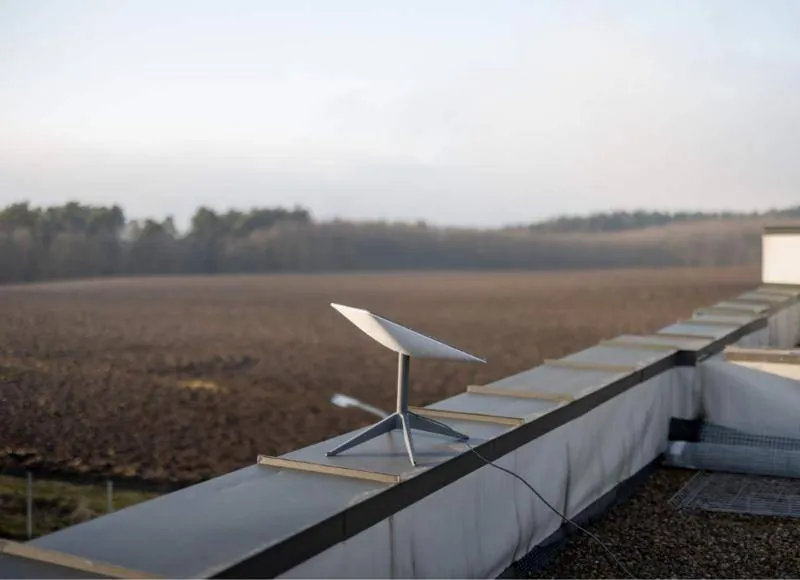
Starlink dish on a roof next to a field
Smart AgricultureRoot zone soil moisture in real time
Equipment

The sensors we install

Wireless and battery-powered, with no cabling. Battery life depends on how often they send readings.

SensorSoil moisture sensor
MeasuresVolumetric moisture, temperature and, on some models, soil conductivity
Where it goesIn the root zone, usually 20 to 60 cm deep depending on the cropGood contact with the soil matters. After installation, readings take a few days to settle.
SensorWeather station
MeasuresTemperature, humidity, rainfall, wind speed and direction, radiation
Where it goesIn an open part of the farm, away from trees and buildingsAll-in-one multi-parameter stations make installation and maintenance simpler.
SensorValve controller
MeasuresSolenoid valve opening and closing, often flow too
Where it goesIn the valve box or at the main irrigation manifoldYou can control it manually from your phone or with rules based on moisture.
SensorGreenhouse sensor
MeasuresTemperature, air humidity, CO₂, light
Where it goesIn the centre of the greenhouse, at crop height, in a shaded housingDirect sun distorts the temperature reading, so we use a radiation shield.
SensorLevel sensor
MeasuresWater level by ultrasound or pressure
Where it goesTanks, cisterns, boreholesThe ultrasonic sensor fits in the tank lid without touching the water.
Alerts

Know before damage is done

Soil moisture drops below 25%The grower gets an alert, or the valve opens automatically for a set time.
Ground-level temperature approaches 0 °CThe grower gets an SMS with the current temperature and the trend over the last hour.
Greenhouse temperature exceeds the limitAn alert to open vents or shading, or the fans switch on automatically.
The tank drops below 20%The grower gets an alert to schedule a refill or change the irrigation programme.
How we work

How we set up the system on your farm

  1. Getting to know the farm

    We learn about your crop, the soil, the irrigation system and where there is power and internet.

  2. Measurement points

    We choose representative points for the soil sensors, based on irrigation zones and differences in soil.

  3. Gateway and coverage

    We place the gateway on a high point and check the signal across the farm. Where needed, we add solar power and 4G or Starlink.

  4. Sensor installation

    We install soil sensors, the weather station and valve controllers, and confirm that all readings reach the dashboard.

  5. Limits and first season

    We set initial limits and adjust them with you during the first season, based on how the crop responds.

FAQ

Frequently asked questions

Can't find what you're looking for? Call us or send us a message.

How many soil sensors do I need?
You need at least one per irrigation zone with uniform soil and crop. If your farm has big differences in slope or soil type, we suggest more points. We draw up the plan with you after the visit.
Why is the limit 25%?
It is an indicative limit for this example. The right value depends on the soil type, since sandy soil holds much less water than clay, and on the crop. We set limits per sensor during the first season.
Does it work on a farm with no power or internet?
Yes. The sensors run on batteries or solar panels. The gateway can run on a small solar panel with a battery and connect to the internet over 4G or Starlink.
How long does a soil sensor battery last?
With a reading every 15 to 30 minutes, batteries usually last a few years. Battery life is shorter if readings are more frequent or the sensor is far from the gateway.
Can the system irrigate on its own?
Yes, with valve controllers. You can set rules, for example open the valve for 40 minutes when moisture drops below a limit and skip watering if it has rained. You can always step in manually from your phone.
Can the sensors survive machinery and field work?
Soil sensors go in the tree or plant row, away from the path of machinery. We mark them clearly and mount the electronics on a post above the ground.

Tell us about your farm

Tell us your crop, area and irrigation system, and we will suggest the right measurement points.