


Wind load
Wall bracket or ballast mount suited to the spot, with the cable tied down along its route.
Starlink installation in the Cyclades, on Mykonos, Santorini, Paros, Naxos, Syros, Tinos, Milos and the smaller islands. We fix the dish so the meltemi cannot move it, and place it so it does not spoil the look of the house or the village.
A Starlink installation in the Cyclades is not like one in town. The dish is exposed to strong wind for weeks on end, the roof is usually flat, whitewashed and visible to the neighbours, and many properties are only open a few months a year.
Fixed-line quality varies a lot from island to island and village to village. The Chora may have a good connection, while a house among the dry-stone walls outside the village has only mobile data, which in summer is often stretched by the crowds. There, Starlink becomes the main connection, or a backup for the days the line cannot cope.
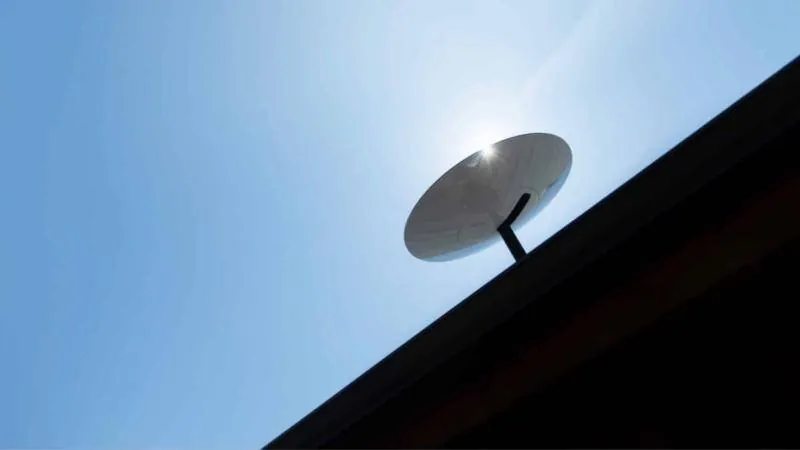
The meltemi blows mainly in July and August, with gusts that easily exceed what a makeshift mount can take. The ground stand that comes with the kit is meant for temporary use: on a Cycladic roof we never leave it on its own.
We prefer a metal bracket fixed to a solid wall or parapet, as low as the sky view allows. Where we cannot drill, we use a ballast mount with weight chosen for the exposed spot. The cable is tied down along its whole route so it does not flap or pull on the connector.
Salt carried by the wind quickly corrodes ordinary screws and brackets. We use stainless or galvanised fittings and outdoor-rated trunking.
In the Cyclades the look of a house matters, both to the owner and to the village. We look for a spot that cannot be seen from the street or the sea, behind a parapet or next to a chimney, without losing the sky the dish needs. The cable runs in white trunking or through existing conduits.
We do not break the whitewash and waterproofing of the roof without reason. Where an entry point is needed, we seal it so no water gets in over winter. If you want the dish as low as possible, we can also discuss the Flat High Performance kit, which has a flat profile.
In traditional settlements and areas of archaeological interest, there may be rules on antennas and equipment on roofs. We are not planning engineers, so we suggest checking with your engineer before installation.
Cycladic villas and small hotels are often spread over several levels, with rooms in separate buildings, a pool and terraces. The kit's router alone is not enough. We design wired access points or mesh, cable runs between buildings and outdoor coverage.
Guests go on a separate network from reception, the booking system and the cameras. For properties with many rooms we look at whether more than one dish is needed, or a combination with the fixed line on a failover router, and explain the business plans Starlink offers.
Most properties open in spring. The best time to install is March to May, so the connection is tested before the first guests arrive and before the meltemi starts. In winter, Starlink offers pause or standby options depending on the plan, with terms on starlink.com/gr.
On the islands, short power cuts and voltage swings are not unusual. A UPS keeps the dish and router running through brief cuts and protects them from sudden changes. We size it to the consumption of the kit and the rest of the network equipment, and wire it so cameras and alarm stay online too.
Wall bracket or ballast mount suited to the spot, with the cable tied down along its route.
As few roof penetrations as possible, and any we make sealed for winter.
Low profile, a spot hidden from the street, white trunking on white walls.
A UPS for the dish, router and cameras, so a short cut does not drop the connection.
A separate guest network and coverage in rooms, terraces and by the pool.
Send us photos of the roof, the horizon and the places where you do not want the dish visible, plus a map pin.
We propose a spot, mount type, kit and coverage plan, with a written estimate that includes the trip.
We book a date around the ferries, ideally before the season. We configure the router, access points and UPS in Athens.
We secure the dish, run the cable and check signal and speed in every room and outdoor area.
We show you how to check the connection. Most settings can also be changed remotely during the season.
Can't find what you're looking for? Call us or send us a message.
Starlink for business doesn't stop at the dish. We set it up as part of your network, with failover, firewall, VPN and…
See the pageA business Wi-Fi installation starts with measurements, not with buying equipment. We place access points where they…
See the pageFrom the survey and mounting through to the app on your phone. Cameras that see the spots that matter clearly, record…
See the pageSend us photos of the roof and tell us which island. We will suggest a spot, a meltemi-proof mount and a coverage plan, with a written estimate.